It's the question that comes up before every course purchase: "is the certificate actually worth anything?" The honest answer is yes — just not in the way most people hope. Let's look at what a Udemy certificate is, how to get one, how hiring managers read it, and the situations where it genuinely does work for you.
What a Udemy certificate is
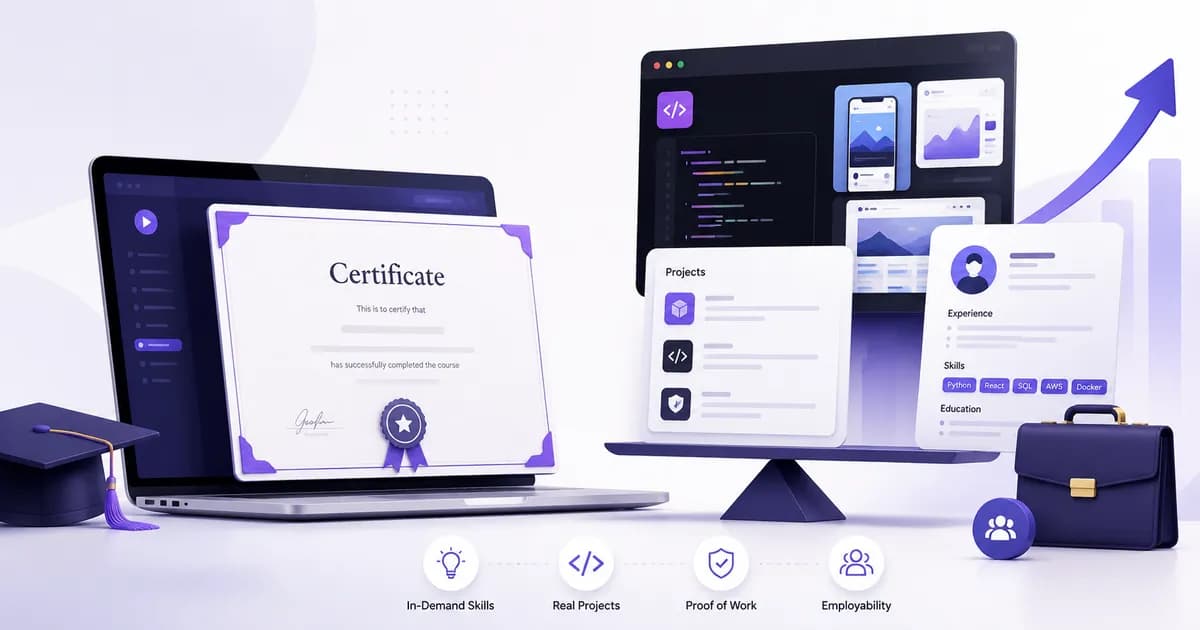
A Udemy certificate is a certificate of completion. It's issued automatically once you've marked every lecture in a course as finished, and it carries the course title, the instructor's name, your name, the length in hours, and a unique verification link.
One fact determines everything else: the certificate confirms that you went through the course, not that you learned the material. There's no exam and no independent assessment of your knowledge. It is not an accredited educational document, and it is not a professional certification.
Certificates are issued for paid courses only. Udemy's free courses don't come with a certificate of completion — one of the main differences between the free and paid catalogs.
How to get the certificate
- Finish the course — every lecture marked complete.
- Open the course page under "My learning".
- Click through to the certificate and download the PDF.
- Optionally add it to the "Licenses & certifications" section of LinkedIn — Udemy provides a direct link for that.
For a course you bought outright, the certificate never expires and can be downloaded at any time. One exception: for courses taken through the Personal Plan subscription, access to the certificate goes when the subscription does. If you received the course as a gift and redeemed the gift code, the certificate is issued exactly the same way — how the course was purchased makes no difference.
Do employers value a Udemy certificate?
Directly — barely. No serious hiring manager will invite you to interview because you watched 40 hours of video. And that's fine: a certificate of completion was never designed to be proof of competence.
Indirectly — yes, in three situations:
- As a signal of self-direction. A list of finished courses on a junior's résumé shows they can teach themselves and see things through.
- As an answer to "where did this skill come from?" When your résumé claims a tool your previous job never used, the course explains its origin.
- Inside a company. For internal promotion, performance reviews, or reimbursement of learning expenses, formal proof of completion is often all that's required — and a Udemy certificate covers that.
How it compares to other credentials
| Credential | What it proves | Weight in hiring |
|---|---|---|
| Udemy certificate | Course completion | Low, indirect |
| Coursera university certificate | Completion with graded assignments | Medium |
| Professional certificate (Google, IBM, Meta) | A structured program with practice | Medium, recognizable |
| Vendor certification (AWS, Cisco, Microsoft) | A passed exam | High, sometimes mandatory |
| University degree | A multi-year program | High in certain industries |
A full platform comparison is in Udemy vs Coursera. The short version: if what you need is the words "university certificate" on a résumé, Udemy doesn't deliver that. If what you need is the skill, it delivers it better and for far less.
The strongest combination for a résumé: a Udemy course gives you the skill, a vendor exam gives you the formal proof. Plenty of Udemy courses are built specifically to prepare you for those exams — look for "certification" or the exam code in the title.
What actually drives hiring
The order in which a hiring manager evaluates a candidate with no experience:
- Projects you can open and click through. A repository, a deployed app, a case study with numbers.
- Understanding demonstrated in a technical interview. This is where the course earns its price — but only if you wrote code by hand instead of watching video in the background.
- Relevant experience, however small: freelance work, a side project, an internship.
- Formal credentials — vendor certifications, a degree.
- Course completion certificates — dead last on the list.
The takeaway is straightforward: buy the course for the skill and the portfolio project, and treat the certificate as a pleasant side effect. If a course doesn't end with a project of your own, its value is close to zero — PDF or no PDF.
Frequently asked questions
Can a Udemy certificate be verified?
Yes. Every certificate carries a unique udemy.com link that lets anyone confirm the document is genuine and see who it was issued to. Udemy sets out when a certificate is issued and how it is verified in Certificates of Completion: FAQ.
Should I list Udemy courses on my résumé?
As a junior, yes — one line under education, and only the relevant ones. As an experienced specialist, no: your projects and work history speak louder. Never let a résumé turn into a list of fifteen certificates.
Is an English-language certificate a problem?
No. The certificate is issued in the platform's language, and that causes no trouble anywhere: the name, the course title, and the verification link all read unambiguously.
If the course was a gift, do I still get a certificate?
You do. A redeemed gift course is fully equivalent to one bought directly — same lectures, same updates, same certificate. The mechanics are covered in the guide to paying for Udemy from Russia.
Conclusion
A Udemy certificate isn't a ticket into a profession and never was. It confirms that you completed a course, helps explain where a skill came from, and looks reasonable in a beginner's education section. Everything else is done by your projects.
So choose a course by its curriculum and its practice, not by the certificate it promises — which is what the checklist for choosing a course is for. Browse subjects and prices in the course catalog.
Buy Udemy Courses
Paste a course link → pay by card, crypto, or another supported method → get access in 2 minutes
Check Course Price