Udemy is an open marketplace: a course can be published by an engineer from a major tech company, or by someone paraphrasing documentation they read last week. The catalog is enormous, quality is uneven, and the price is nearly identical either way. Which is why knowing how to choose a Udemy course saves you more than any sale ever will. Here's the checklist to run before you buy.
Why the choice matters more than the price
A course on sale costs $13–15, and finishing it will take you somewhere between 20 and 60 hours. Your time is worth dozens of times the course. A bad pick doesn't cost you money — it costs you a month spent on outdated material you'll have to unlearn.
The conclusion is simple: spend ten minutes vetting the course. It's the highest-return investment in the whole process.
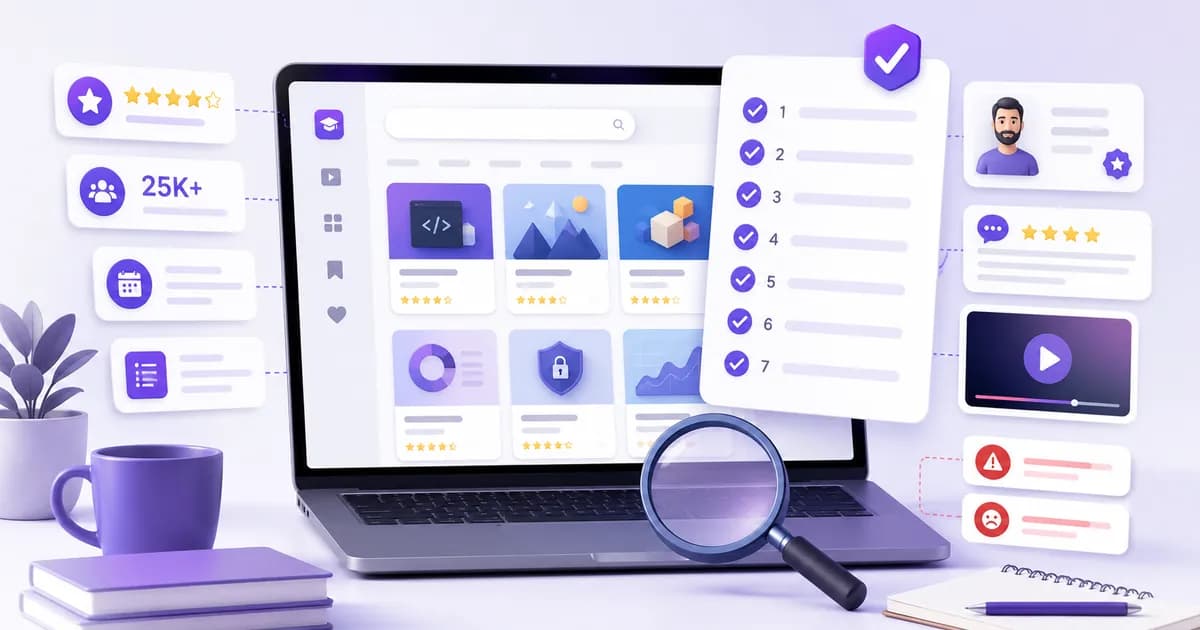
The checklist: 7 signs of a good course
1. Rating of 4.5+ — with a lot of ratings behind it
A 4.9 from 40 reviews means nothing; those are the instructor's friends and earliest buyers. A 4.6 from 80,000 ratings is a strong signal. Read both numbers together, and always prefer sample size over a pretty average.
2. It was updated recently
Udemy shows a last-updated date on every course page. For stable subjects — algorithms, core Python, English — a two-year-old course is fine. For frameworks, cloud platforms, and anything tied to tool versions, a course older than about eighteen months is already drifting away from reality.
3. A detailed curriculum, not three bullet points
Expand the full table of contents. A good course lists every lecture with a title and a runtime, and you can see it move from simple to complex. Vague section names like "Advanced topics" with nothing underneath mean the instructor never structured the material themselves.
4. There's practice, not just video
Look for projects, exercises, and graded assignments in the curriculum. A course that's nothing but watching someone else's code creates the illusion of understanding: everything is clear until you sit down to write it yourself.
5. The instructor is a practitioner
Open their profile: how many courses, how many students, what they do besides teaching. One strong course from a working engineer beats twenty shallow ones from someone whose only income is courses.
6. Recent reviews, not just old ones
Sort reviews by date. This year's reviews matter more than three-year-old praise: they tell you whether the course's code still runs today and whether the instructor answers questions in the Q&A.
7. The free preview makes sense to you
Most courses open a few lectures for preview. Watch a couple of minutes: is the pace, diction, and audio quality workable? If you're fighting the accent instead of the material ten minutes in, this isn't your course — no matter what the rating says.
Red flags
Signs a course should be skipped, even at the lowest price:
- Fewer than a thousand ratings behind a huge promise ("become a senior in 30 days").
- No update date at all, or nothing touched for three-plus years in a fast-moving subject.
- Reviews complaining that the code is outdated and that the instructor never answers the Q&A.
- Not a single project in the curriculum.
- The instructor promises you a job. A marketplace course can guarantee nothing about employment — that's marketing.
A category of its own: the "10 languages in one course" bundle. Breadth is almost always bought with depth. You'll get one introductory lecture per topic and a false sense that the topic is closed.
Vetting a course in ten minutes
The sequence below filters out nearly every bad purchase:
- Check the rating and the number of ratings — 30 seconds.
- Find the last-updated date — 15 seconds.
- Expand the curriculum and scroll to the bottom — 3 minutes.
- Open the instructor's profile — 1 minute.
- Sort reviews by date and read five recent ones — 3 minutes.
- Play two minutes of a free preview lecture — 2 minutes.
Clears all six? Buy it. Trips on two or more? Back to search.
Don't pay the list price. Check the current cost first — Udemy almost always has a promotion running, and a course listed at $84.99 really sells for $13–15. The mechanics are in the post on Udemy sales and discounts.
Where to start, by subject
If you haven't settled on a topic yet, it's easier to start from a subject than from a specific course:
- Programming from scratch — Python courses remain the gentlest entry into software. There's a ready-made shortlist in the best Python courses for beginners.
- Web development — JavaScript courses: the one language you can't route around on the front end.
- Everything else — from 3D and game development to marketing and English — is in the topic catalog.
Frequently asked questions
Which matters more, the rating or the student count?
The number of ratings. An average is easy to inflate on a small sample; a hundred thousand ratings can't be faked. Filter by volume first, then compare ratings within what's left.
Should I buy an English-language course if my English is weak?
Often yes. The technical English used in courses is simple, auto-generated subtitles exist, and code on screen speaks for itself. But if the language genuinely blocks you at the start, take a course in your native language first — absorption speed beats immersion at that stage.
Can I return a course that doesn't fit?
Yes, within 30 days — but the window runs from the purchase, and the refund is addressed to whoever paid. If the course arrived as a gift, the most on offer is Udemy credits via support, and that at Udemy's discretion. Ten minutes of vetting before you buy is worth more than any guarantee.
Conclusion
A good Udemy course is recognizable by four things: a lot of ratings, a recent update date, a detailed curriculum with real practice, and an instructor who actually practices. Everything else is detail.
Vetted your course and ready to buy? Paste its link on the homepage to see the price, and the step-by-step guide covers how to pay when your card isn't accepted.
Buy Udemy Courses
Paste a course link → pay by card, crypto, or another supported method → get access in 2 minutes
Check Course Price